The Miami Dolphins are entering what many around the league believe is a full rebuild. After major roster turnover and a shift in leadership, the franchise appears to be focused on building a new identity. Instead of speed-first offensive fireworks, the Dolphins may now be looking to construct a tougher, more balanced roster built through the trenches and a revamped defense. In this mock draft simulation, Miami leaves the draft with a mix of high-value selections, physical offensive linemen, and long athletic playmakers on defense.
Pick 11 – Caleb Downs – S – Ohio State
Analysis:
At pick 11, the Dolphins would be getting tremendous value if Caleb Downs is still on the board. Many analysts believe he is a top-five player in the entire draft class. Fans will look at this and say there is no way he falls this far, but we see surprises every year. The same thing was said when Kyle Hamilton slid further than expected. Players fall every year. It is only called a fall when a player gets drafted lower than analysts predicted.
Caleb Downs is officially 100% healthy and just put on a clinic at the Ohio State Pro Day.
— KingZephyr (@KingZahyd) March 25, 2026
If your team is picking in the Top 10 and needs a franchise safety, are you taking him or passing for a QB? Jets and Giants fans, talk to me. https://t.co/oLs34PdBYw
In this mock simulation Downs was still available, and if that happens the Dolphins should sprint the card to the podium. Miami is in a rebuild, and the best way to start is with a tone-setter on defense. With very few established defensive leaders on the roster, Downs could step into that role immediately. He becomes the centerpiece of a defense the Dolphins can build around.
Pick 30 – Emmanuel Pregnon – G – Oregon
Analysis:
The Dolphins must rebuild the interior offensive line, and Emmanuel Pregnon is an excellent place to start. Pregnon is widely considered one of the best interior offensive linemen in the class and many teams ahead of Miami could easily take him. If he is available here, the Dolphins land a potential cornerstone.
Pregnon played the majority of his snaps at left guard and has the size, strength, and athleticism to step into the lineup immediately. In a rebuild, finding long-term anchors in the trenches is critical, and Pregnon has the tools to be a centerpiece of Miami’s offensive line for the next five to ten years.
Pick 49 – Chris Brazell II – WR – Tennessee
Analysis:
Chris Brazell II is an easy selection here. Big, tall, fast, and crafty, Brazell brings a different style to the Dolphins receiver room. For years Miami built their offense around smaller speed receivers. The new direction may be something different.
Instead of fast smurfs, the Dolphins may be building around fast trees.
Brazell has elite size combined with deep speed and refined route-running ability. He creates matchup problems immediately and becomes a large outside target that can stretch the field vertically.
Pick 75 – Keylan Rutledge – G – Georgia Tech
Analysis:
Pregnon played most of his snaps at left guard. Keylan Rutledge played most of his snaps at right guard. That makes this pairing feel almost perfect.
Both players are plug-and-play interior linemen who could stabilize the offensive line immediately. While some teams chase flashy picks during a rebuild, Miami is prioritizing substance.
Rutledge graded out well at Georgia Tech and brings a serious mentality to the position. When we interviewed him, it was clear he approaches the game with one mission: dominate the man across from him. He is the type of lineman you want next to you when things get physical. The alley guy. The guy ready to take on three defenders if necessary.
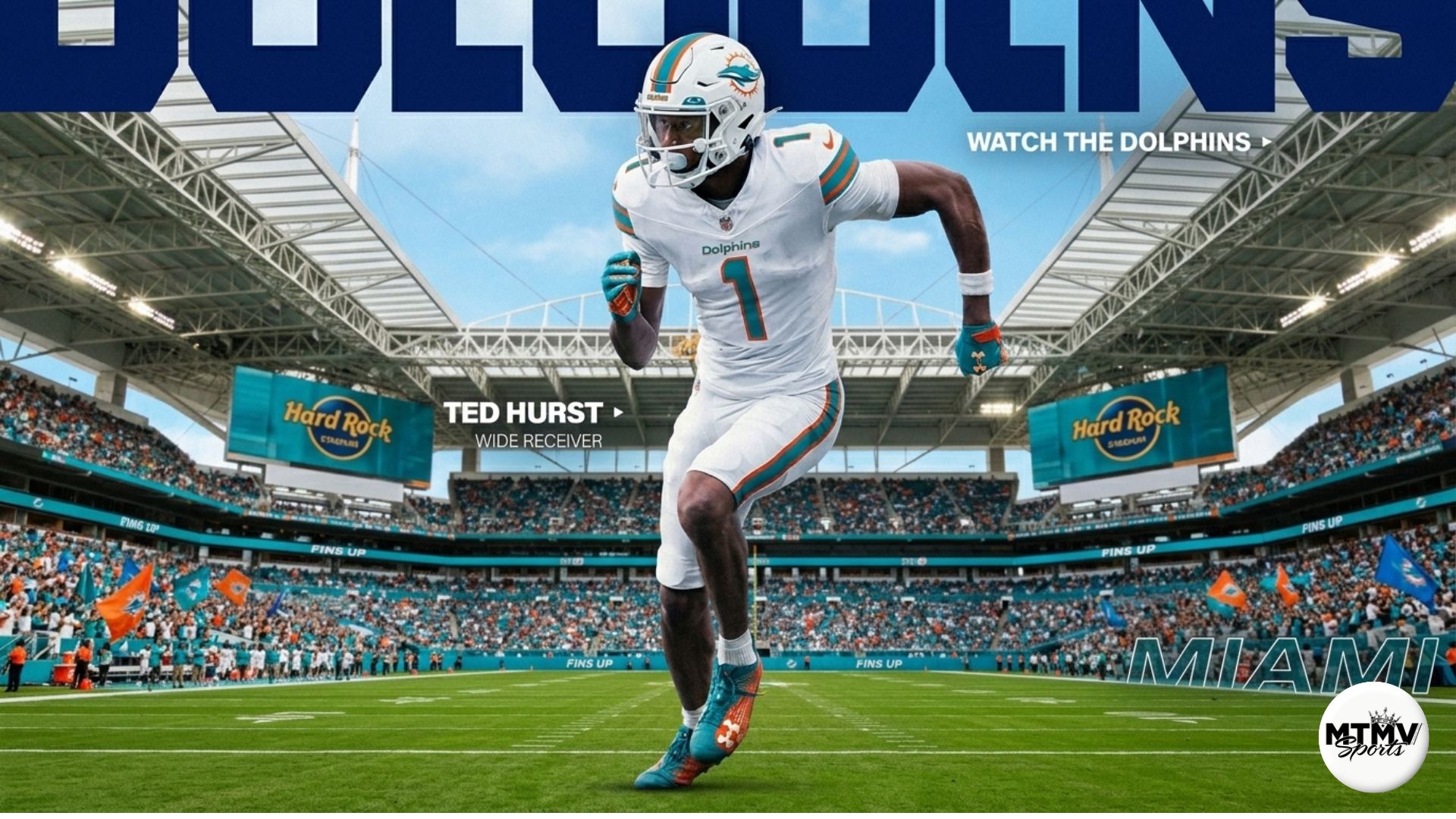
Pick 87 – Ted Hurst – WR – Georgia State
Analysis:
Another fast tree joins the Dolphins receiver room.
Ted Hurst stands around 6’3, weighs over 210 pounds, and reportedly runs a 4.4 forty-yard dash. Pairing him with Brazell could create serious matchup problems for smaller cornerbacks.
Hurst still needs to polish his route running, but his production at Georgia State and his performance at the Senior Bowl significantly raised his stock. He bullied defensive backs throughout his final season and showed he belongs against top competition.
Pick 90 – Genesis Smith – S – Arizona
Analysis:
Pairing Genesis Smith with Caleb Downs could give the Dolphins one of the most intriguing young safety duos in the league.
Miami has struggled to stabilize the secondary in recent years, and this pick continues the rebuild of the defensive backfield. Smith has shown strong coverage ability and versatility, which would complement Downs perfectly on the back end of the defense.
Pick 94 – Jonah Coleman – RB – Washington
Analysis:
After major roster turnover, the Dolphins have very few established offensive weapons remaining. One player still on the roster is De’Von Achane, whose explosive speed makes him dangerous but also someone the team will want to keep healthy.
Pick 97 – Malik Muhammad – CB – Texas
Analysis:
Muhammad brings the exact type of athletic profile teams look for when drafting outside corners. At 6’0” and 188 pounds, he ran a 4.42 forty with a 39-inch vertical and a 10’10 broad jump, confirming the explosive traits needed to survive on the boundary at the next level.
Malik Muhammad, CB, Texas
— David (@DavidNeiszPHL) January 24, 2026
21, twitchy, quick trigger, hips to mirror receivers tightly. Thrives in zone, making him a natural Philly fit.
Toolsy, physical & instinctive.
He's a great interview & should develop into a disruptive playmaking corner.pic.twitter.com/kuoZ4vBIzg
At Texas he played primarily outside corner, logging over 500 snaps on the perimeter while also showing the ability to rotate into the slot or box when needed. His run defense grade also stands out for the position, showing a willingness to tackle and support the run game — something Jeff Hafley has historically valued in his defensive backs.
Muhammad is the type of corner that fits well in a defense that wants physical outside coverage and versatility in the secondary. In a rebuild, adding young athletes with starting potential is critical, and Muhammad has the traits to eventually develop into a reliable outside corner.
Pick 130 – Tim Keenan III – DT – Alabama
Analysis:
Keenan gives Miami a true interior presence along the defensive line. At 6’2” and 320 pounds, he spent the majority of his snaps at Alabama lining up directly over the interior gaps, primarily working in the A and B gaps where his job was to control space and disrupt the run game.
His production reflects that role. Keenan posted a strong run-defense grade while consistently absorbing blockers and helping collapse running lanes. While his pass-rush numbers are modest, his value comes from his ability to hold the point of attack and keep linebackers clean behind him.
For a Dolphins defense that needs to rebuild its front seven, Keenan adds size and physicality to the interior rotation. Players with his frame and experience in the SEC often develop into reliable rotational defensive tackles at the next level.
Pick 151 – Ephesians Prysock – CB – Washington
Analysis:
Prysock brings rare size to the cornerback position. Standing 6’4” with 4.45 speed and elite explosive testing numbers, he profiles as one of the more intriguing developmental corners in this class.
At Washington he primarily played outside corner but also logged snaps in the slot and box, demonstrating versatility in the secondary. His strong run-defense grade shows he is comfortable playing downhill and engaging physically — a trait that fits well with defensive systems that expect corners to contribute in the run game.
Corners with Prysock’s length and athleticism are difficult to find. While he may still be developing as a pure cover corner, his physical tools give Miami a high-upside defensive back who could grow into a matchup weapon against bigger receivers.
Pick 227 – Vincent Anthony Jr. – EDGE – Duke
Analysis:
Anthony is a classic traits-based selection late in the draft. At 6’6” and 260 pounds, he possesses the type of length and frame that NFL teams covet in edge defenders.
His production at Duke shows flashes of pass-rush ability, recording seven sacks and multiple quarterback pressures during the season. While his run defense metrics suggest he is still developing as a complete edge defender, his size and athletic profile give him tools that cannot be taught.
For a rebuilding team, late-round picks are often about upside. Anthony’s physical traits give Miami a developmental pass rusher who could grow into a rotational edge defender with the right coaching.
Pick 238 – Cole Payton – QB – North Dakota State
Analysis:
Payton is one of the more intriguing developmental quarterbacks in this class. At 6’3”, 233 pounds, he tested as one of the better athletes at the position, running a 4.56 forty while posting elite explosion numbers including a 40-inch vertical.
On the field, Payton was highly efficient during his final season at North Dakota State. He completed over 71 percent of his passes while producing a very high deep passing grade and an excellent big-time throw rate. Just as important, he kept turnover-worthy plays extremely low.
In the late rounds, teams often look for quarterbacks with physical tools and production who can be developed over time. Payton checks both boxes and gives Miami a developmental quarterback with intriguing upside.