
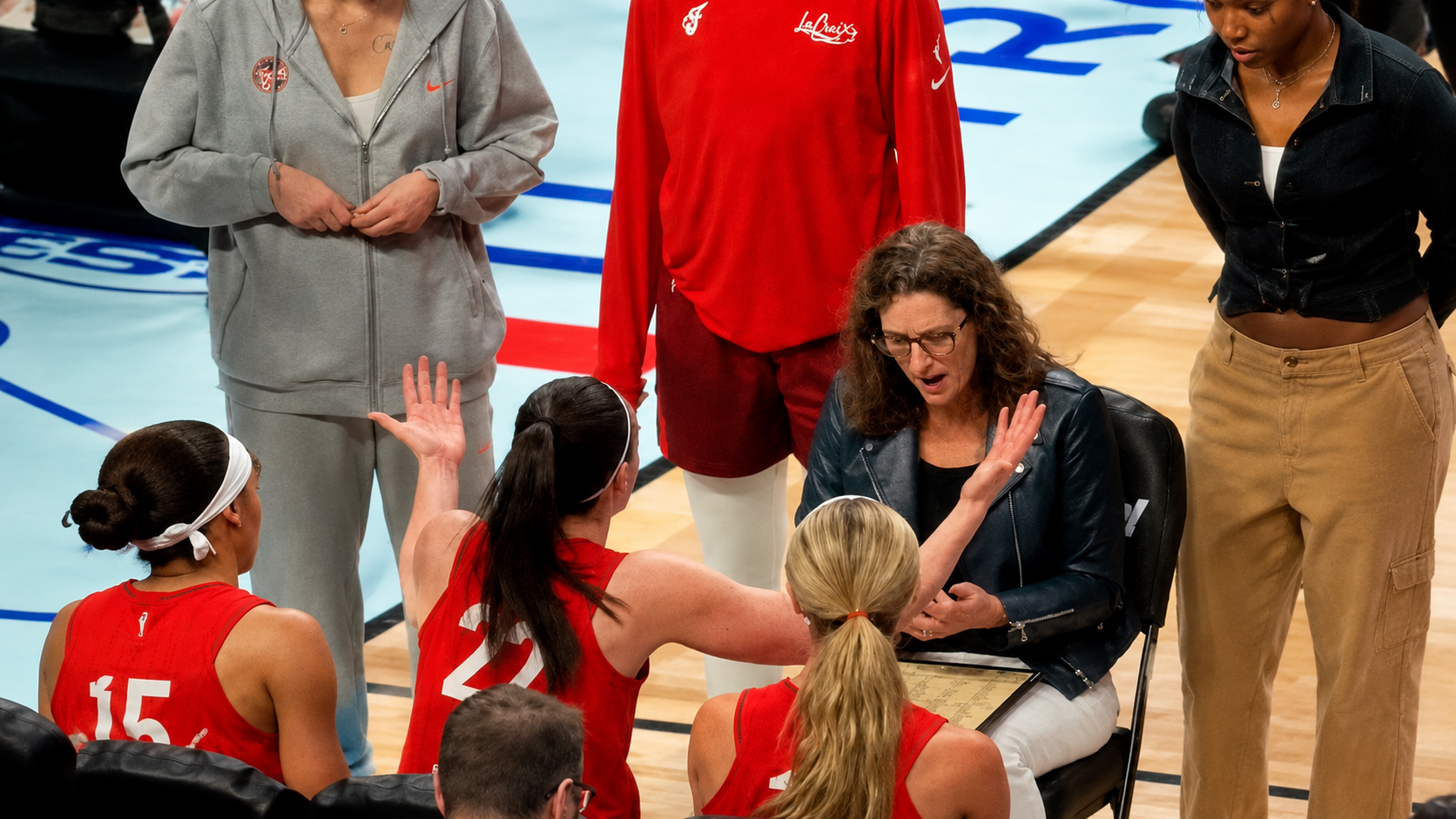
The Indiana Fever have a problem.
Not a Caitlin Clark problem.
Not a Stephanie White problem.
An identity problem.
And the longer this season goes on, the harder it becomes to ignore.
After another frustrating performance, much of the conversation centered around Caitlin Clark’s turnovers, her visible frustration with coaches, and her defensive struggles. Critics pointed to her five turnovers, late game mistakes, emotional interactions on the sideline, and defensive possessions where opponents appeared eager to attack her.
Whether those criticisms are entirely fair is beside the point.
The real question is much bigger:
Can Caitlin Clark and Stephanie White coexist long term?
The Magic Johnson Parallel
That may sound dramatic, but basketball history has seen this story before.
Before Pat Riley became a coaching legend with the Los Angeles Lakers, there was Paul Westhead.
Westhead inherited a championship team led by Magic Johnson. After Magic suffered an injury, Westhead adjusted the Lakers’ style of play. The team found success with a different approach while Magic was sidelined.
The problem came when Magic returned.
The offense that had evolved without him no longer fit what made Magic special. Instead of adapting the system to the superstar, the system expected the superstar to adapt.
The relationship deteriorated.
Cheryl Miller shares her thoughts on the heated exchange between Caitlin Clark and Stephanie White 👀 pic.twitter.com/q4naKR1KdY
— Yahoo Sports (@YahooSports) May 31, 2026
Eventually, Magic went to ownership, Westhead was fired, and Pat Riley took over. The rest is NBA history.
No, Caitlin Clark is not Magic Johnson.
And no, Stephanie White is not Paul Westhead.
But the situation raises a similar question.
What happens when a coach discovers success without their franchise star?
I thought Fever FC was trolling but now I genuinely think Stephanie White might prefer Raven Johnson as her PG1 over Caitlin Clark
— Gio (@jsmove7) May 31, 2026
“ Stephanie white told me we play faster when she’s the 1 ” 💀 pic.twitter.com/MfcFWznu2G
The Fever’s Success Without Clark
One uncomfortable reality for Fever fans is that Indiana showed signs of functioning effectively during stretches when Clark was unavailable.
The ball moved differently.
The offense looked different.
Roles became more traditional.
And that’s where things get interesting.
Stephanie White has always been viewed as a more traditional basketball coach. She values structure, defensive accountability, execution, and disciplined point guard play.
That’s one reason some observers believe players like Raven Johnson fit the type of point guard White naturally gravitates toward.
Clark is the exact opposite.
She thrives in chaos.
She pushes pace.
She attempts passes others would never consider.
She takes risks.
When it works, it creates highlights few players in basketball can produce.
When it doesn’t, it creates turnovers and frustration.
The challenge for White is determining how much freedom to allow.
The challenge for Clark is accepting coaching while still being herself.
In these clips Caitlin isn’t fast enough to stop players from driving past her. Nor is she strong enough to impede their progress. The result is points or a foul. pic.twitter.com/Z1HcYaGv3W
— Kevín (@KevOnStage) May 31, 2026
The Defensive Elephant In The Room
Perhaps the biggest concern isn’t Clark’s turnovers.
It’s her defense.
Opposing teams have increasingly targeted Clark in isolation situations.
That isn’t unique to her. Nearly every elite offensive guard in basketball history has experienced opponents hunting favorable matchups.
The difference is perception.
When a player is carrying a massive offensive load, defensive shortcomings are often overlooked.
When the offense struggles and the defense struggles simultaneously, criticism multiplies.
Fair or unfair, Clark’s defensive effort, positioning, and ability to stay in front of quicker guards have become recurring talking points around the league.
That puts White in a difficult position.
As a coach, you have to address those issues.
But how do you coach a player who also happens to be the biggest star in the history of your franchise?
Thought Steph left her fire in Connecticut! 🥵 pic.twitter.com/meFefzUAAf
— Mostly WNBA Tweets (@MostlyWNBA) May 31, 2026
Amber Cox Has A Decision Coming
This is where Fever General Manager Amber Cox enters the conversation.
Because eventually organizations have to decide what they want to be.
Do they want to maximize Caitlin Clark?
Or do they want to maximize Stephanie White’s system?
The ideal answer is both.
But sports history tells us that isn’t always possible.
If White believes the best version of Indiana basketball requires a different style than Clark naturally plays, tension will continue to grow.
If Clark believes the system limits what makes her special, frustration will continue to grow.
At some point, someone has to adapt.
The superstar.
The coach.
Or the front office.
Two-time runner-up Caitlin Clark and WNBA champion assistant coach Briann January share a quick moment on the bench. ✨ pic.twitter.com/V8vlBsbfNm
— I talk hoops 🏀 (@trendyhoopstars) May 19, 2026
Who Would Indiana Choose?
If this situation ever reaches a breaking point, the answer seems obvious.
Franchises almost always choose the superstar.
Especially when that superstar is responsible for unprecedented television ratings, attendance records, merchandise sales, national attention, and revenue.
Clark isn’t just a player.
She’s an economic engine.
The Fever are experiencing visibility they have never experienced before.
That reality matters.
A lot.
But winning matters too.
And that’s why this story is far from simple.
The Fever do not need Caitlin Clark fanatics.
They do not need Stephanie White loyalists.
They need basketball people who care about one thing:
Finding a way for their superstar and their coach to pull in the same direction.
Final Thoughts
Because if they can’t?
Indiana may eventually face the same question the Lakers faced decades ago.
Not whether Caitlin Clark is talented.
Not whether Stephanie White can coach.
But whether both can succeed together.
And right now, that’s a question nobody can confidently answer.
(Article co-authored by Chris Dawson)