
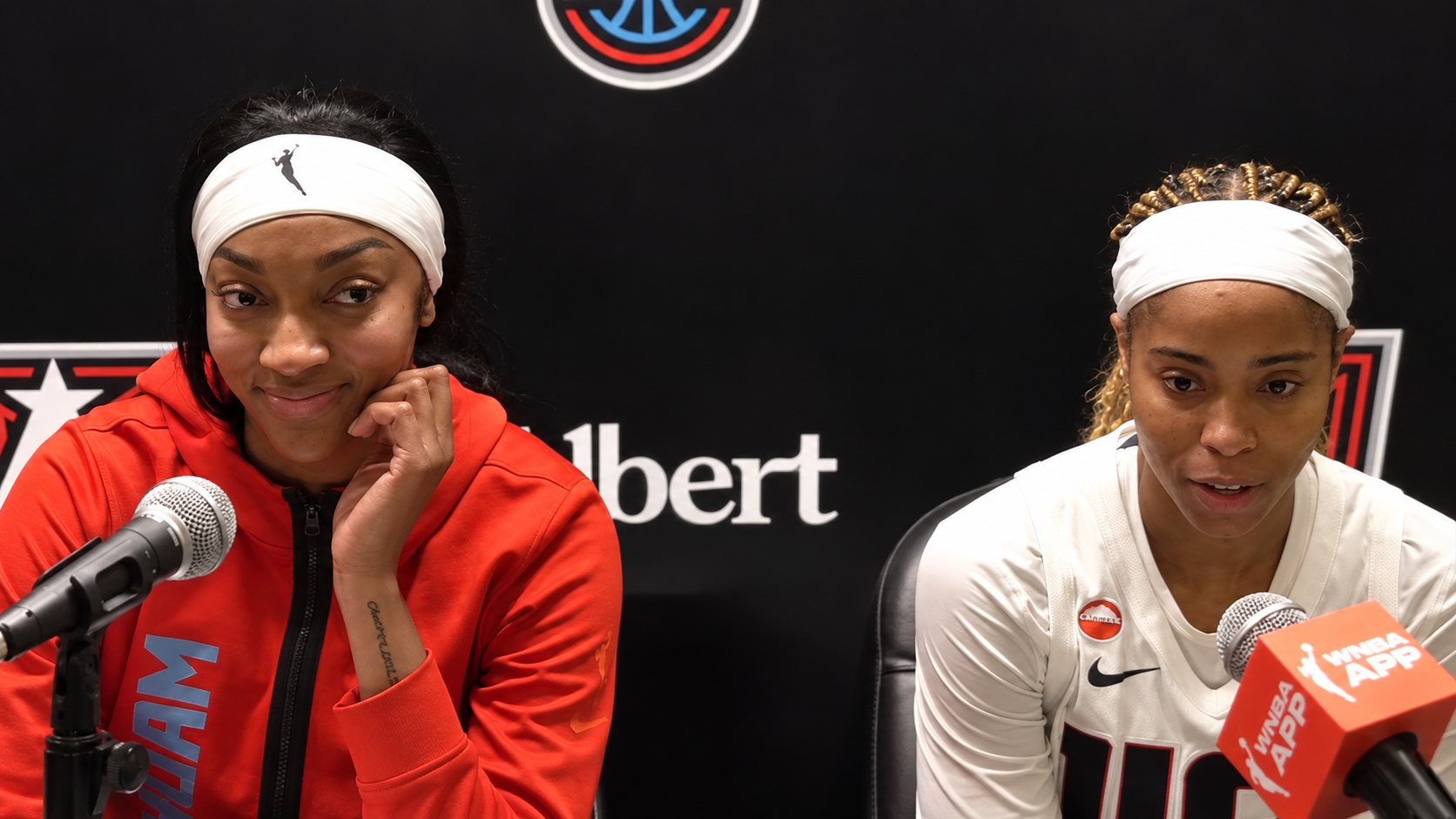
Jordin Canada scored 19 points as the Atlanta Dream defeated the New York Liberty 95-84 Monday Night in New York.
The Atlanta Dream are playing like champions, and the addition of DeWanna Bonner may be helping Atlanta solve some of the problems that once showed up at the worst possible times.
Timely threes. Timely steals. Open-court layups. Critical rebounds.
Bonner has given Atlanta another player capable of making winning plays without needing the offense to revolve around her.
Her length matters defensively and on the glass. Her experience matters late in games. And on a Dream team whose starters have routinely carried heavy minutes, Atlanta has shown the conditioning and stamina to continue attacking teams deep into the fourth quarter.
But Bonner’s biggest contribution might not appear anywhere in the box score.
She has a voice, and the Atlanta Dream are listening.
That is significant because Bonner did not walk into a locker room searching for leadership.
Atlanta already has it.
Naz Hillmon has established herself as one of the team’s vocal leaders. Jordin Canada directs traffic from the point. Allisha Gray and Rhyne Howard have been foundational pieces of the franchise. Angel Reese has brought an unmistakable intensity that Canada says has spread throughout the entire team.
“She sets the tone,” Canada said of Reese after Atlanta’s win in New York. “You can tell she wants it really bad, and we’re there. We have her back every single day.”
Canada went even further, saying Reese has brought something Atlanta had been missing.
“You see the change in our team. You see the aggressiveness, the intensity factor, just the energy.”
So how does Bonner enter an already tight-knit locker room filled with established personalities and immediately become one of its most influential voices?
Because leadership isn’t always about who talks the loudest. Sometimes it’s about who has already been where everyone else is trying to go.
Bonner brings that credibility.
Reese described her as both a “big sister” and an “auntie,” joking about Bonner’s longevity before explaining exactly why her experience has become so valuable.
“She gives us a lot of intel about what it takes,” Reese said.
More importantly, Bonner sees things younger players may not recognize yet.
“She notices things that I may not notice or the rest of the team may not notice,” Reese explained. “She knows the things that will matter down the long road and long stretch.”
That may be the most important part of Bonner’s impact.
She isn’t attempting to replace Atlanta’s existing leadership structure. She is adding another layer to it.
The WNBA is also a uniquely connected league. Players compete against each other throughout the season, play together internationally, share All-Star locker rooms and build relationships that often extend well beyond one franchise. A player arriving from another team isn’t necessarily arriving among strangers.
Respect can precede the jersey.
And Bonner arrived in Atlanta with something else that matters: a championship standard.
After Atlanta’s win in New York, Reese revealed that Bonner was already talking about home-court advantage and the importance of opening a playoff series in front of the Dream’s own fans.
Even after a major road victory, Bonner wasn’t allowing the team to become satisfied.
“We can be happy for these next hour, two hours,” Reese recalled Bonner telling the team, “but we got to get ready for the next game.”
That’s championship behavior.
Celebrate the win. Study the mistakes. Move on.
Reese said Bonner keeps Atlanta’s confidence high while simultaneously refusing to allow the team to become comfortable.
“We can never get comfortable with her because she expects a lot out of us,” Reese said.
Then came the statement that may explain everything:
“That’s why she came to Atlanta, because she believes that she can win a championship with us.”
That belief appears to be mutual.
Bonner isn’t walking into the locker room telling the Dream what they could become. She is reinforcing what Atlanta’s players already believe about themselves.
Canada made that clear when she was asked about the perception of the Dream as a championship contender.
“We think we’re a championship team, and we’re proving it,” Canada said. “We believe in our team. Everybody in that locker room, that’s all that matters.”
That’s why Bonner’s voice works.
She isn’t trying to convince Atlanta that it belongs.
She is teaching Atlanta what comes next when you already believe you do.
There is a difference between talent and championship execution. There is a difference between playing well in September and understanding which possessions, mistakes and habits become magnified in the postseason.
Bonner has lived through those moments.
Now she can identify them before Atlanta has to learn every lesson the hard way.
And perhaps the most dangerous thing about this version of the Dream is that Bonner isn’t the only player holding teammates accountable.
Canada talked about trust. Reese talked about teammates telling her things she may not want to hear but needs to hear. Players are pushing each other in practice. They are encouraging each other to keep shooting. They are picking each other up when someone struggles offensively.
That’s not one leader.
That’s a locker room developing collective accountability.
Bonner simply adds the perspective of someone who knows what that accountability is supposed to produce.
Atlanta already had the talent.
Atlanta already had leaders.
Atlanta already believed it could win.
DeWanna Bonner didn’t come to Atlanta to change any of that.
She may have come to show the Dream how to finish it.