
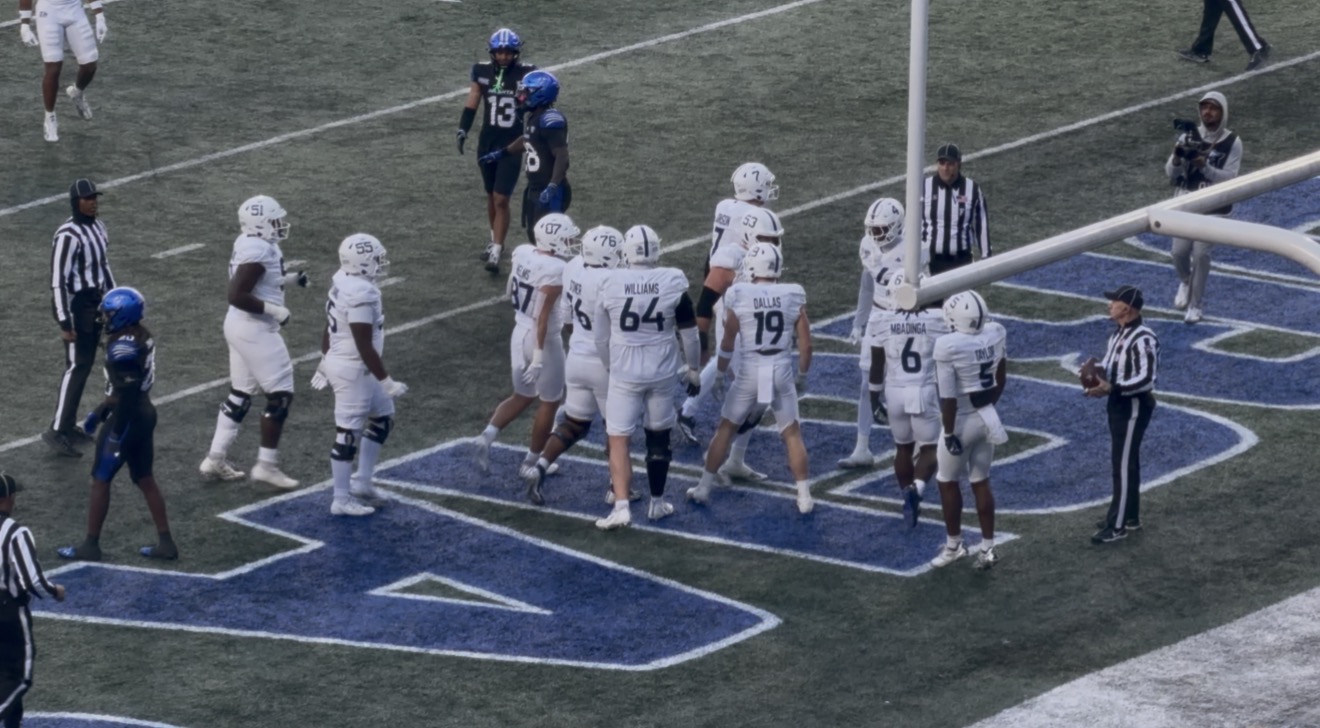
ATLANTA, Ga. — November 14, 2026
Georgia State and Georgia Southern entered Saturday’s rivalry matchup with identical 5–4 overall records, but their positions in the Sun Belt Conference told two very different stories. Georgia Southern entered the contest at 4–1 in conference play, firmly in the hunt for the Sun Belt East Division title. Georgia State, meanwhile, came into the afternoon at 2–3 in conference play, looking for an opportunity to close the gap in the standings and disrupt its rival’s championship aspirations.
With James Madison sitting atop the division at 5–2 in conference play, Saturday’s matchup carried significant implications for both programs. A victory for Georgia Southern would strengthen its position in the East Division race, while a Georgia State win would hand the Eagles a critical conference loss and give the Panthers an opportunity to move closer to contention.
For Georgia State, the opportunity to shake up the division began with a promising first quarter. However, as the game unfolded, a troubling pattern emerged: Georgia State was only capitalizing on opportunities created by its defense and special teams, while Georgia Southern was consistently finding ways to move the football on offense.
That difference ultimately proved decisive as Georgia Southern pulled away for a 34–17 victory, delivering a significant blow to Georgia State’s conference aspirations while strengthening its own position in the Sun Belt East.
The Panthers wasted little time taking advantage of Georgia Southern’s early struggles. After a muffed punt by the Eagles gave Georgia State possession deep in Southern territory, the Panthers quickly capitalized on the short field.
After a muffed punt led to a fumble by Georgia Southern, Georgia State recovered deep in enemy territory. State quickly turned that easy red-zone opportunity into a touchdown.
— MTMV Sports Network (@MTMVSN) November 14, 2026
The score is now 7-0, Georgia State early. pic.twitter.com/zlG3JhIfyB
Running back Qwantavius Wiggins punched the football into the end zone from three yards out with 8:18 remaining in the first quarter. Samer Layous converted the extra point, giving Georgia State an early 7–0 advantage.
However, Georgia Southern responded with an impressive offensive possession. The Eagles marched 75 yards in eight plays, consuming 3:48 of game clock before Tyrese Woodgett finished the drive with a one-yard touchdown run. Tripp Bryant added the extra point, tying the contest at seven with 4:30 remaining in the opening quarter.
The response highlighted a significant difference between the two offenses. While Georgia State needed a special teams mistake to establish favorable field position, Georgia Southern demonstrated its ability to sustain a drive and move the football downfield.
Georgia State’s defense would soon provide another opportunity. Following a sack that forced the Panthers’ offense to punt, Georgia Southern committed another costly mistake, fumbling the football and giving Georgia State possession just seven yards from the end zone.
The Panthers needed only one play. Lanear McCrary Jr. took the handoff and powered into the end zone for a seven-yard touchdown with 38 seconds remaining in the first quarter. Layous converted the extra point, putting Georgia State back in front, 14–7.
Through one quarter, the Panthers had scored twice and held a seven-point advantage over their in-state rivals. However, both touchdowns came on possessions that began inside Georgia Southern’s 10-yard line. Georgia State had converted its opportunities, but it had yet to demonstrate an ability to consistently move the football down the field.
The Eagles needed just 14 seconds of the second quarter to erase Georgia State’s advantage. On the first play of the period, quarterback Max Johnson connected with River Helms for a 52-yard touchdown reception, completing a three-play, 75-yard scoring drive that lasted only 47 seconds. Bryant’s extra point tied the game at 14.
The explosive play illustrated what was becoming an increasingly concerning trend for Georgia State’s defense. While the Panthers had successfully forced turnovers, they struggled to prevent Georgia Southern from generating significant yardage when the Eagles maintained possession.
Georgia Southern continued to move the football throughout the second quarter. With 5:04 remaining before halftime, Bryant connected on a 42-yard field goal, capping a six-play, 55-yard drive that gave the Eagles their first lead of the afternoon, 17–14.
The Eagles were not finished. With less than three minutes remaining in the half, Johnson orchestrated another sustained offensive possession, moving Georgia Southern 82 yards in 11 plays. The drive concluded when Johnson connected with Josh Dallas for a 13-yard touchdown reception with just 25 seconds remaining before halftime. Bryant converted the extra point, extending Georgia Southern’s lead to 24–14.
After trailing 14–7 late in the first quarter, the Eagles had scored 17 unanswered points, completely reversing the momentum of the rivalry matchup.
Despite forcing two turnovers and converting both into touchdowns, Georgia State entered halftime trailing by 10 points. The statistical disparity between the teams revealed just how dramatically Georgia Southern had controlled the game.
The Eagles accumulated 291 yards of total offense in the opening half, compared to just 69 yards for the Panthers. Georgia Southern averaged an impressive 8.6 yards per play, while Georgia State managed only 2.6.
Perhaps the most alarming statistic for the Panthers was their inability to establish a passing attack. Georgia State quarterback Ayden Pereira completed just three of five passes for six yards in the opening half. Meanwhile, Johnson was nearly flawless, completing 14 of 15 passes for 181 yards and two touchdowns.
Georgia Southern also received contributions from its rushing attack, with Taeo Todd gaining 42 yards on four carries and David Mbadinga adding 36 yards on six attempts. The Eagles’ offensive production was particularly impressive considering they had already committed two turnovers.
Georgia State, on the other hand, had yet to turn the football over but was struggling to sustain possessions. The Panthers actually held a slight advantage in time of possession, controlling the football for 16:14 compared to Georgia Southern’s 13:46. However, that advantage did little to offset the enormous difference in offensive production.
Trailing 24–14 at halftime, Georgia State desperately needed an offensive spark. Once again, that opportunity came following a critical turnover forced by the Panthers’ defense. But this time, Georgia State’s offense delivered something it had struggled to produce throughout the first half: an explosive play.
With 10:05 remaining in the third quarter, Lanear McCrary Jr. took a handoff from Georgia State’s 33-yard line and exploded through the middle of the defense for a 49-yard gain, advancing the football all the way to Georgia Southern’s 18-yard line.
The run represented a significant breakthrough for a Panthers offense that had managed just 69 total yards throughout the entire first half. In one play, McCrary generated nearly as much yardage as Georgia State’s entire offense had produced through the opening two quarters.
However, despite reaching the red zone, the Panthers were unable to finish the possession with a touchdown. Samer Layous eventually connected on a 37-yard field goal with 7:58 remaining in the third quarter, cutting Georgia Southern’s advantage to 24–17.
The five-play, 48-yard scoring drive brought Georgia State within one possession and briefly shifted momentum back toward the Panthers. For a moment, it appeared that Georgia State might be finding the offensive rhythm necessary to challenge Southern.
But the Eagles had an answer. Rather than allowing Georgia State to build on its third-quarter momentum, Georgia Southern responded with another methodical offensive possession.
The Eagles moved 40 yards in nine plays, consuming 4:06 of game clock before Bryant connected on a 41-yard field goal with 3:44 remaining in the third quarter. The kick extended Georgia Southern’s advantage to 27–17.
While the possession produced only three points, its impact extended beyond the scoreboard. Georgia Southern’s ability to sustain drives was becoming increasingly important as the game progressed. The Eagles were finding success on the ground, controlling the tempo, and forcing Georgia State to spend valuable time watching from the sidelines.
For the Panthers, the challenge was becoming clear. Georgia State needed to generate points, but Georgia Southern’s rushing attack was making every remaining possession increasingly valuable.
As the contest moved into the fourth quarter, Georgia State still had an opportunity to make things interesting. Trailing 27–17, the Panthers moved into field-goal range with a chance to reduce Southern’s advantage to seven points. However, the attempt sailed wide, leaving the Eagles’ 10-point lead intact.
A successful kick would have brought Georgia State within one touchdown and an extra point of tying the game, potentially increasing the pressure on Southern’s offense. Instead, the Panthers remained two possessions behind. With Georgia Southern consistently finding success on the ground, the missed field goal made an already difficult comeback attempt even more challenging.
However, Georgia State’s defense wasn’t finished fighting. The Panthers forced a quick three-and-out on Georgia Southern’s ensuing possession, giving their offense another opportunity to make things interesting.
Georgia State responded by moving the football downfield and once again putting itself in field-goal range. It was exactly the type of offensive response the Panthers desperately needed. But for the second consecutive opportunity, Georgia State came away empty-handed.
Another missed field goal left the Panthers trailing 27–17, squandering a second opportunity to cut into Southern’s advantage. The sequence was particularly frustrating for Georgia State because its defense had done its part.
After surrendering lengthy scoring drives throughout the afternoon, the Panthers had finally forced a quick stop and given their offense another chance. Yet, despite moving into scoring position on consecutive possessions, Georgia State had nothing to show for either opportunity.
Six potential points were left on the field in a game where every possession had become increasingly valuable. With the clock continuing to wind down, Georgia State’s comeback hopes were fading, and Georgia Southern was about to deliver the final blow.
If Georgia State still had hopes of mounting a late comeback, Weston Bryan effectively ended them with one explosive play. With Georgia Southern leading 27–17 in the fourth quarter, the Eagles put together another impressive offensive possession.
Southern moved 75 yards in six plays, consuming 3:37 of game clock. Then, with 4:11 remaining in the contest, Bryan broke free for a spectacular 54-yard touchdown run, racing into the end zone and delivering the decisive blow to Georgia State’s comeback hopes.
Bryant converted the extra point, extending Georgia Southern’s advantage to 34–17.
The touchdown was a fitting conclusion to an afternoon defined by Georgia Southern’s offensive versatility. Earlier in the contest, Johnson had punished Georgia State through the air, connecting on explosive passing plays that helped erase the Panthers’ early advantage.
As the game progressed, the Eagles increasingly relied on their rushing attack to sustain possessions and control the clock. Bryan’s touchdown combined both elements of Southern’s offensive success: a sustained drive followed by a devastating explosive play.
What had been a competitive rivalry matchup early in the afternoon had turned into a commanding Georgia Southern victory. The Eagles went on to secure the 34–17 win, handing Georgia State a costly conference defeat.
Georgia State’s defense deserves credit for repeatedly creating opportunities throughout the afternoon. The Panthers forced multiple turnovers, including two early takeaways that directly resulted in touchdowns. However, the offense struggled to establish consistency outside those opportunities.
Georgia State’s first two touchdown drives covered a combined 16 yards, illustrating just how heavily the Panthers relied on favorable field position. Meanwhile, Georgia Southern repeatedly demonstrated its ability to move the football regardless of where its possessions began.
The Eagles produced touchdown drives of 75, 75, 82, and 75 yards, showcasing an offense capable of sustaining long possessions while also generating explosive plays. Even after Georgia State forced another turnover in the third quarter, Southern responded with a methodical scoring drive that restored its 10-point advantage.
When the Panthers missed two critical fourth-quarter field goals, the Eagles delivered the knockout punch through Bryan’s 54-yard touchdown run. Georgia State consistently needed Georgia Southern to make mistakes to create scoring opportunities. Georgia Southern simply needed the football.
That distinction defined the afternoon.
The victory improves Georgia Southern to 6–4 overall and 5–1 in Sun Belt Conference play, strengthening the Eagles’ position in the East Division race. Georgia State falls to 5–5 overall and 2–4 in conference play, leaving the Panthers with significant ground to make up in the standings.
For Georgia Southern, Saturday’s victory demonstrated the type of offensive balance that could prove valuable as the conference race continues. Johnson’s first-half efficiency, the Eagles’ ability to sustain lengthy drives, and Bryan’s explosive fourth-quarter touchdown all contributed to a performance that overcame multiple turnovers.
For Georgia State, the loss raises important questions about offensive consistency. The Panthers demonstrated that their defense could create opportunities against a talented conference opponent, but the inability to sustain drives and consistently produce points ultimately prevented them from taking advantage.
Georgia State entered the afternoon with an opportunity to shake up the Sun Belt East standings. Instead, Georgia Southern strengthened its position in the conference race.
Final Score: Georgia Southern 34, Georgia State 17.
In a rivalry game where turnovers initially gave Georgia State the advantage, it was Georgia Southern’s ability to control the football, sustain drives, and deliver explosive plays that ultimately made the difference.