The Tampa Bay Buccaneers ended the 2025 season missing the playoffs, falling short of expectations despite flashes of a competitive roster.
The Buccaneers approached free agency with a clear plan to reinforce depth while maintaining flexibility, bringing in key contributors on both sides of the ball. Offensively, the addition of Kenneth Gainwell gives Tampa Bay a versatile back who can contribute in both the run and pass game, while re-signing Cade Otton keeps continuity in the passing attack. Along the offensive line, addingrs Justin Skule and retaining Dan Feeney provides much-needed depth and flexibility in the trenches. Defensively, the Buccaneers focused on reinforcing their front seven and linebacker room, signing A’Shawn Robinson to strengthen the interior and bringing in Alex Anzalone and Christian Rozeboom to improve range and tackling at the second level. The addition of Al-Quadin Muhammad adds rotational pass rush help, while Miles Killebrew contributes on special teams and provides veteran depth in the secondary. While these moves raise the floor of the roster, they did not fully address Tampa Bay’s biggest weakness, which remains defending the pass.
With the first pick in the first round I’m going with wide receiver Jordyn Tyson out of Arizona State. Losing a legend in Mike Evans after years of reliability at the WR position is tough. Tyson may not be able to replace that reliability but he definitely has elite ability and that can help as he battles with Emeka to see who emerges as the new WR1 in Tampa. Tyson brings strong production and efficiency, highlighted by an 82.9 Pro Football Focus (PFF) grade, along with a low drop rate that signals reliability. He projects as a dynamic playmaker who can line up both outside and in the slot, giving Baker Mayfield another weapon and helping diversify the offense. However, taking a receiver in the first round instead of addressing the secondary may raise questions considering the team’s struggles against the pass.
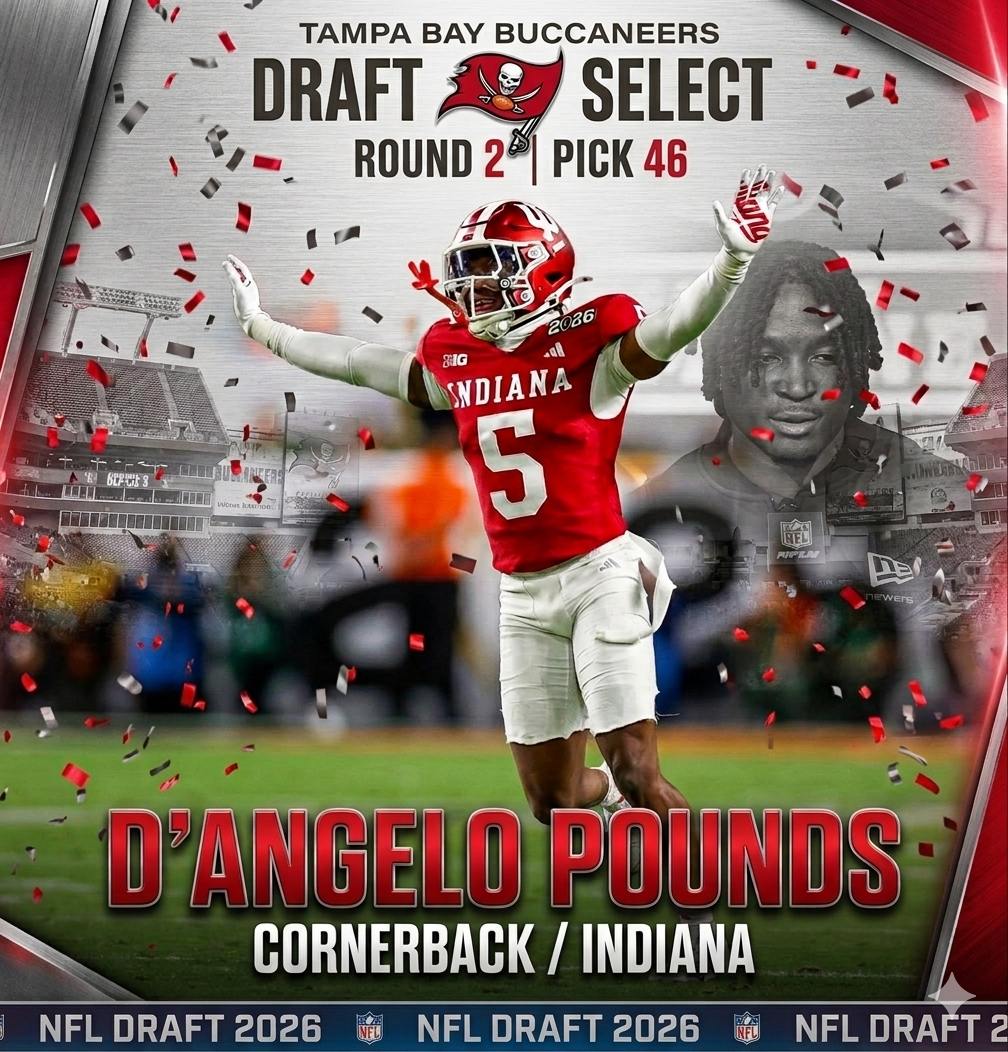
In the second round, the Buccaneers address that need by selecting cornerback D’Angelo Ponds from Indiana, a highly productive defender with elite ball production and consistency. Ponds posted an outstanding 89.9 PFF grade while allowing just 32 receptions on 64 targets and holding opposing quarterbacks to a 55.4 passer rating. His instincts, competitiveness, and ability to make plays on the ball give him clear starter potential, though his size at 5’9” and 173 pounds could present challenges against bigger NFL receivers. However, the greatest cornerback in Bucs history was also under 5’11 and only two pounds heavier. Barber was also significantly slower running a 4.6 to Ponds’ 4.3. Emory Hunt often says size is not a skill, meaning that you can’t measure the skill of a player based on his size. His skill level is high, and he has the ability to be special.
The third-round selection of tight end Max Klare from Ohio State adds another dimension to the offense. At 6’5” and 243 pounds, Klare is a receiving-focused tight end with reliable hands and the ability to contribute in the passing game. His production and versatility suggest he can develop into a valuable weapon, though his inconsistency as a blocker may limit his early-down usage until that part of his game improves.
In the fourth round, Tampa Bay takes a developmental swing at quarterback Drew Allar from Penn State. Allar has shown flashes of high-level play, including an 82.2 grade in 2024, but his performance dipped in 2025. He possesses the size, arm talent, and tools to develop into a starting-caliber quarterback, making him an intriguing long-term investment behind Baker Mayfield if he can regain consistency and improve under pressure. He has 1st round tools, but playing QB is far more about decision making, information processing, rhythm, timing, discipline, accuracy, and leadership skills. Allar has yet to prove that he is elite in those areas.
The fifth-round pick, guard Jeremiah Wright from Auburn, addresses the interior offensive line with a player who has shown steady improvement. Wright logged over 700 snaps and allowed pressure but also demonstrated growth with a 68.2 grade in 2025. He projects as a developmental lineman with starting potential, capable of providing depth early and competing for a larger role over time.
In the sixth round, the Buccaneers select safety Lorenzo Styles Jr. from Ohio State, a versatile defensive back who logged snaps across multiple alignments, including slot and deep coverage. Styles brings flexibility and athleticism, but his overall PFF grade of 66.0 suggests he is still developing and may need time before becoming a consistent contributor at the NFL level.
The draft concludes with edge rusher Vincent Anthony Jr. from Duke in the seventh round, a high-upside prospect with ideal length at 6’6” and 260 pounds. Anthony flashes as a pass rusher with natural tools and finesse, but he must improve his strength and physicality to earn significant playing time. As a late-round pick, he represents a developmental option who could grow into a rotational contributor.
Overall, this mock draft for Tampa Bay could earn a solid B-plus grade by adding offensive firepower and developmental depth, but it leaves some questions unanswered about whether enough was done early to fix the team’s biggest issue in pass defense. If the Buccaneers can develop their young defensive pieces and get immediate production from players like Ponds, this class has the potential to outperform expectations.