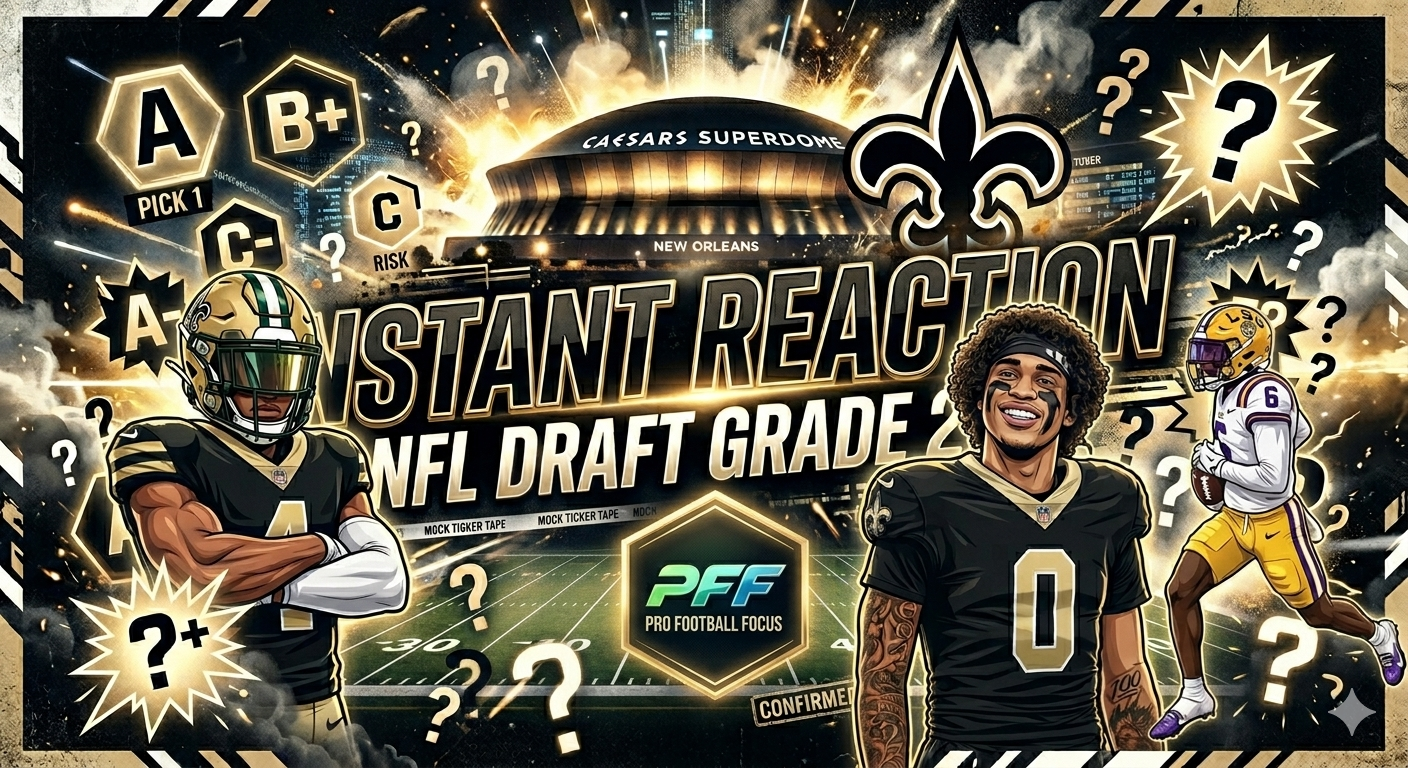
There are grades, and then there is reality. When it comes to the New Orleans Saints’ 2026 draft class, PFF’s mock draft simulator handed out a D+ overall grade, placing the class in the bottom 18% of all simulated drafts. On the surface, that number raises eyebrows. But once you dig into how the simulator actually works and what had to be done to replicate the Saints’ real-life approach, the story becomes much more layered.
Before even getting to the grades themselves, a few concessions have to be made.
There may be a glitch in the PFF draft simulator right now, but it created a unique opportunity. Instead of just running a standard mock, this was about doing something different: recreating the Saints’ actual draft as closely as possible inside the simulator and seeing how PFF would evaluate it.
That was not as straightforward as it sounds.
PFF clearly valued certain players much higher than where the Saints were able to draft them in real life. Defensive tackle Christen Miller, wide receiver Bryce Lance, and cornerback TJ Hall all carried stronger internal grades in the simulator. Because of that, trades had to be made just to land those same players. To secure Miller, a move was made up to the end of Round 1 with Seattle. To grab Lance, it required jumping 20 spots with the Colts. And to ensure Hall was available, another deal with Indianapolis had to be completed.
In other words, this was not just a plug-and-play scenario. It was a reconstructed version of the Saints’ class inside a system that values players differently.
And that difference in valuation is where the grading disconnect begins.
Round-by-Round Breakdown
Round 1, Pick 8: WR Jordyn Tyson (Arizona State) — Grade: C
This is where the conversation starts, and honestly, where it already begins to split between film and formula. Tyson fills a clear need for the Saints as a bigger-bodied receiver with speed and explosiveness. The concern, as noted before, is durability. But what stood out in his pre-draft process, especially in private workouts, was his ability to move with real juice. PFF sees this as average value at the spot. The Saints see a potential WR1 if he stays healthy.
Trade Up to Pick 32
Recognizing value discrepancies, a move was made to align with PFF’s board and still land a key piece.
Round 1, Pick 32: DI Christen Miller (Georgia) — Grade: B+
This is one of the strongest marks in the class, and it makes sense. Miller is a high-upside defensive lineman with traits that translate immediately. Even with a crowded interior that includes names like Godchaux and Bresee, the Saints continue to invest in size and trench play. PFF rewards that here, even if the real-life question remains about positional redundancy.
Trade Up to Pick 53
Again, necessary to align with the simulator’s valuation.
Round 2, Pick 53: WR Bryce Lance (North Dakota State) — Grade: B
Another solid grade and another receiver. Lance brings versatility and upside, and the Saints clearly doubled down on the position. In a vacuum, this is strong value. In context, it signals a philosophical shift toward surrounding the offense with weapons.
Round 4, Pick 132: TE Oscar Delp (Georgia) — Grade: F
This is where the simulator begins to punish heavily. Delp’s athletic traits, including 4.49 speed, are intriguing. But production concerns and questions about his role in Georgia’s offense weigh heavily in PFF’s grading system. The lack of statistical dominance turns this into a major hit on the overall draft grade. The simulator could be right here there are serious questions about Delp and his lack of production. Was it the UGA offense or does he legit lack a knack to be productive in the passing game. Ross Jackson of Locked on Saints said that this move has Jimmy Graham potential. I find that hard to believe.
Round 4, Pick 136: G Jeremiah Wright (Auburn) — Grade: D
Wright is a developmental lineman with real size and experience. He impressed during Senior Bowl practices and has positional flexibility. However he is a pure RG and is being brought in to compete directly with Ruiz. Can he beat out the vet for a spot in the lineup? The grade says no, but PFF is grading based on perceived value versus draft slot, not projection or fit. That leads to another below-average mark, but maybe the Saints got this one right.
Round 5, Pick 172: S Lorenzo Styles Jr. (Ohio State) — Grade: F
This is another example of the simulator having “very little regard” for a player compared to where he was taken. Styles is a versatile defensive back with upside, but his ranking does not match the selection number, and that disconnect results in a failing grade.
Round 6, Pick 190: WR Barion Brown (LSU) — Grade: D-
This is the clearest example of how the system works against certain picks. Brown is ranked #376 on PFF’s big board, yet he is selected at 190. That gap almost guarantees a poor grade, regardless of player traits. In reality, Brown is a burner with game-breaking speed and upside. In the simulator, he becomes a liability to the overall score.
While this is true Barion Brown made no major impact with the LSU Tigers last year and never truly separated himself. The thing that gives me hope for Brown is the fact that he will be given a very specific role with the Saints. Kick returner.
Trade Up to Pick 214
One more move to secure a targeted player.
Round 6, Pick 214: CB TJ Hall (Iowa) — Grade: C
Hall brings physicality and depth to the secondary. This is more of a neutral grade, reflecting decent value without strong upside according to PFF’s metrics.
Why the Overall Grade Looks Worse Than the Class
The final result is a D+, but that number is heavily influenced by one key factor: PFF’s pre-draft player rankings versus actual selection spots.
This system is not grading purely on talent, fit, or team needs. It is grading on how closely each pick aligns with its internal big board. When there is a large gap, like with Barion Brown, the grade drops significantly. Stack multiple picks like that together, and the overall grade falls quickly.
That does not necessarily mean the Saints had a bad draft.
It means they drafted players the simulator did not value the same way.
Final Thought
This exercise was never about chasing a high simulator score. It was about testing how a real-life draft class would be perceived through a strictly analytical lens.
What it revealed is simple: there is a difference between building a roster and winning a mock draft simulator.
The Saints leaned into traits, upside, and fit. PFF leaned into rankings and value slots.
And when those two philosophies collide, you get a D+ on paper and a much more interesting conversation in reality.