
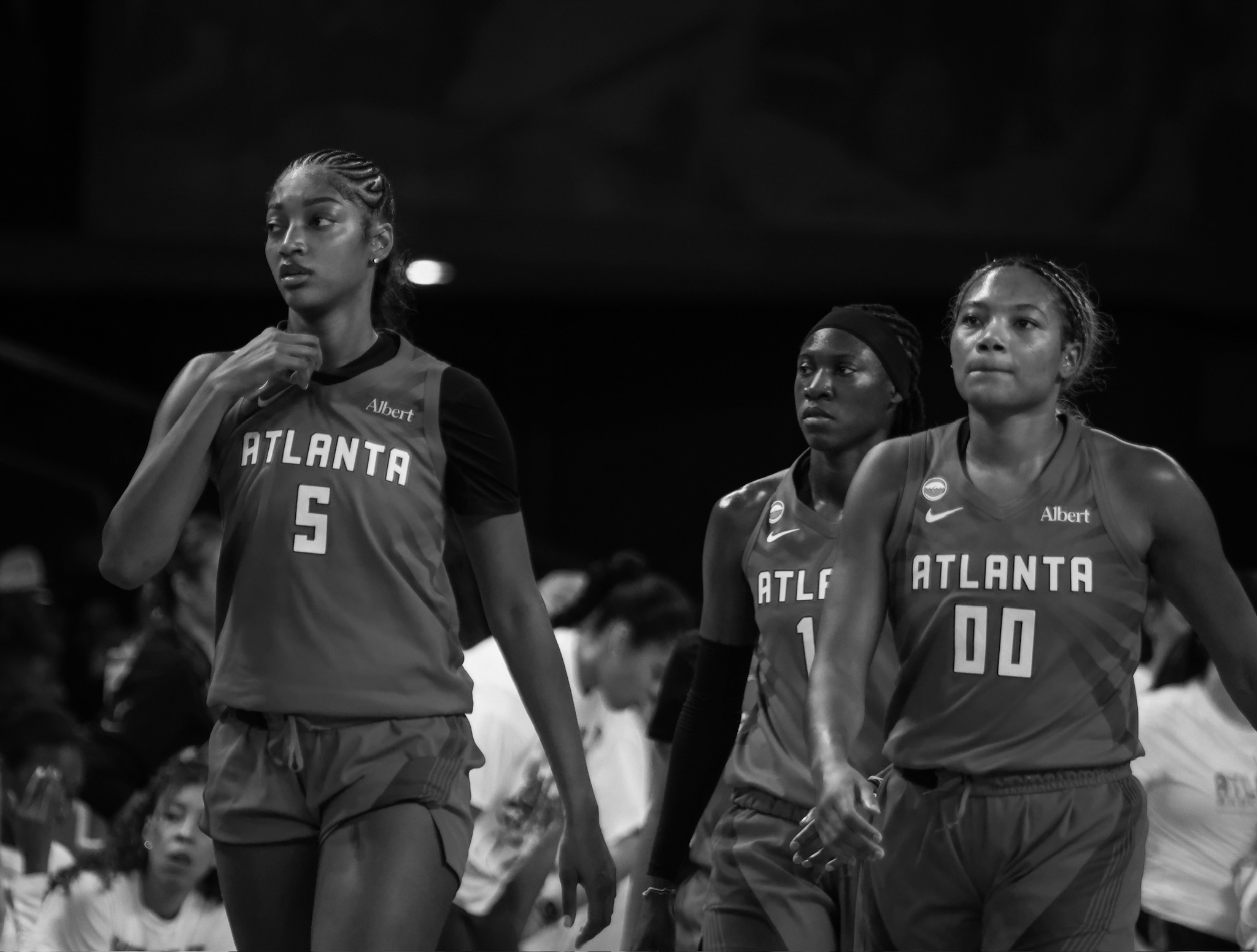
The Atlanta Dream are going to the WNBA Finals.
Writing that sentence at the beginning of this season would have seemed a bit farfetched, but it was the goal of this Atlanta Dream team since the introductory press conference. In a beautiful downtown scene in the heart of Atlanta the Dream introduced Angel Reese to the Atlanta media. However, they were also celebrating the re-signing of all of their core players that had led them to a 30 win record the year before. Allisha Gray was asked about losing in the first round of the playoffs and how she balanced that thought with the excitement of adding Angel Reese and she said it was an easy decision to come back and she wasn’t mad that she was cored, she also said “when everyone else was signed she was excited, but when I heard Angel was coming I was ecstatic. I feel like with the addition of Angel … I feel like she’s the piece that we needed to get us over the hump”. Over the hump meant out of the first round of the playoffs. Prior to the this season the Atlanta Dream had not made it to the Semi-Finals since 2018. However, in that introductory press conference, Rhyne Howard explained what “Over the hump” truly meant to the Atlanta Dream. She said, “Obviously we had the pieces last year, but we came up short,…bringing in somebody like Angel, is special for us because, she could be exactly what we’re missing, everybody is going to do their part, … we want to win, we want to win championships, and we want to do it for a long time.” In order to get that accomplished you have to get to the WNBA Finals, and they have reached that mark for first time since 2013. The Dream are now four wins away from winning their first WNBA championship in franchise history.
In order to get their the Atlanta Dream had to go to New York and win a close-out game in a hostile environment. Jordin Canada’s speed, Angel Reese’s physical presence and a relentless collective effort powered Atlanta past the Liberty 85–83 to complete a three-game sweep and secure a long-awaited return to the championship stage.
For the first time since 2013, Atlanta is headed back to the championship stage, and if you want to understand exactly how the Dream got here, you have to look beyond the final score. You have to look at the emergence of Jordin Canada, the attention Angel Reese commands every time she steps onto the floor, the continued contributions of Rhyne Howard, the veteran leadership of DeWanna Bonner and the willingness of this entire team to do whatever was necessary to win. This wasn’t about one player having a spectacular night. This was about a team understanding what was required to finish the job and executing when it mattered most.
Atlanta defeated the New York Liberty 85–83 on Friday night, completing a three-game sweep of a talented New York team that refused to go quietly. The Liberty had the star power, the experience and the home crowd. Breanna Stewart and Jonquel Jones each finished with 26 points, while Jones added 14 rebounds and three blocks. New York had more than enough talent to make this a difficult matchup, but Atlanta had answers throughout the series, and perhaps the biggest answer of them all was Jordin Canada.

Let’s give Jordin Canada the recognition she deserves, because when we talk about why the Atlanta Dream are advancing to the WNBA Finals, her name belongs at the center of that conversation. Canada has been one of Atlanta’s most important players throughout this series, and her performance in the deciding game was another example of why. She finished with 19 points, 11 assists and zero turnovers in 38 minutes. Nineteen points, 11 assists and not a single turnover in a game that determined whether Atlanta would reach the Finals. That’s a remarkable level of control from a point guard operating under that kind of pressure.
Canada shot 5-of-8 from the field, made her only three-point attempt and went a perfect 8-of-8 from the free-throw line. Her efficiency was impressive, but the numbers only begin to explain her impact. Canada’s speed was a problem New York struggled to solve. Her ability to push the pace, attack openings and put pressure on the defense created a difficult matchup for the Liberty throughout the night. Even when she wasn’t scoring, the threat of her penetration forced New York to account for her movement and created opportunities for Atlanta’s other offensive weapons.
New York’s coach acknowledged the challenge during his postgame press conference, explaining that Canada was attacking before the Liberty could establish their defensive positioning. “Canada was racing us before we could get our shell defense,” he said. That observation gets to the heart of what made Canada so effective. New York couldn’t simply concentrate on Atlanta’s frontcourt because it also had to deal with a point guard capable of getting downhill and creating opportunities for herself and her teammates. Canada wasn’t just managing Atlanta’s offense. She was dictating its tempo, controlling possessions and making sure the Dream continued to generate opportunities. If we’re naming a series MVP based on the impact of these performances, Jordin Canada deserves to be at the very top of that conversation.
Then there’s Angel Reese, and to understand her impact on this series, you have to understand what I’m calling the Angel Reese Rules. It’s a simple concept: You cannot treat the rebounding battle like an ordinary possession when Reese is on the floor. You have to locate her, put bodies around the basket and be prepared to fight for every rebound. Against Atlanta, New York repeatedly faced the challenge of controlling the glass with Reese operating in the paint. That’s the kind of attention she commands, and it’s one of the reasons her influence extends well beyond whatever appears in the final box score.
Reese finished with 22 points, nine rebounds, three assists and two blocks in 37 minutes. She collected five offensive rebounds, giving Atlanta additional opportunities in a game decided by just two points. She also showed another dimension of her offense, connecting on two of her four three-point attempts. While she finished one rebound short of a double-double, that shouldn’t distract from the larger picture. Reese was Atlanta’s leading scorer, and she had to battle against a Liberty frontcourt featuring Jonquel Jones, who delivered an outstanding performance of her own. Reese didn’t need to dominate every statistical category to influence the outcome. She needed to compete, score and force New York to account for her presence, and that’s exactly what she did.
After the victory, Reese described the trust that has developed within Atlanta’s locker room. “This is what you brought me here for. I got your back, you got my back,” Reese said. That statement says a great deal about this Dream team and the mentality that has carried it to this point. Reese wasn’t brought to Atlanta simply to collect individual numbers. She was brought in to help the franchise compete for something bigger, and now the Dream are headed to the Finals.
We also need to talk about Rhyne Howard, because in a series filled with major performances and compelling storylines, Howard’s contributions deserve more attention. She played 38 minutes in the deciding game and finished with 21 points, four three-pointers, one steal and one block. Howard shot 4-of-10 from beyond the arc and helped provide the perimeter scoring Atlanta needed with Allisha Gray not appearing in the game. Not every shot fell, and Howard finished 7-of-21 from the field, but her willingness to remain aggressive mattered. So did her defensive effort and her commitment to competing throughout a demanding matchup.
Howard made it clear after the game that Atlanta’s identity begins on the defensive end of the floor. “Whatever is happening on the other end, our defense never fails us,” Howard said. That is an important statement because Atlanta didn’t reach this point by relying on one player to carry the offense every night. The Dream built a collective approach in which different players could provide the scoring, playmaking or defensive effort required. Howard embraced that responsibility, and when she reflected on reaching the Finals, the significance of the moment was evident. “This is a dream come true. Not only for me, but for the rest of my teammates,” she said. For a player who has invested so much in this franchise, the opportunity to compete on the championship stage carries enormous meaning.
Atlanta’s success wasn’t limited to its three leading scorers. DeWanna Bonner delivered another important performance, finishing with 13 points and 13 rebounds in 32 minutes. Twelve of those rebounds came on the defensive end, and in a matchup where every possession mattered, Bonner’s ability to secure rebounds helped Atlanta finish defensive possessions. Her experience also provided something that doesn’t always appear in a box score. Howard specifically highlighted Bonner’s postseason background during her postgame interview, explaining how much the team values her leadership. That veteran presence matters when a game tightens, the pressure increases and younger players need someone who understands what it takes to navigate those moments.
And then there was Isobel Borlase, whose contributions shouldn’t be overlooked. Borlase scored 10 points in 20 minutes, shooting an efficient 5-of-6 from the field while adding two steals. Those 10 points were significant, particularly with Gray not appearing in the game and Atlanta leaning heavily on its primary rotation. Borlase provided valuable scoring support without needing a high volume of shots. She made five of the six she attempted and gave the Dream another player capable of producing when called upon. Naz Hillmon also contributed four rebounds, three assists and a steal in 32 minutes despite going scoreless, showing that contributions don’t always have to come through points.
Atlanta’s rotation was concentrated throughout the game. Canada and Howard each played 38 minutes, Reese logged 37, and Bonner and Hillmon each played 32. Te-Hina Paopao appeared for three minutes, while several other rostered players did not enter the game. That placed an enormous responsibility on Atlanta’s primary contributors, but this is a group accustomed to carrying significant workloads. The Dream have built their identity around energy, conditioning and sustained effort, and those qualities were on display when the stakes were highest. Their starters were asked to play heavy minutes, maintain their defensive intensity and continue producing offensively, and they answered.
It’s also important to recognize what the Liberty brought to this matchup because this was not a New York team that simply disappeared. Jonquel Jones was outstanding, scoring 26 points on 11-of-17 shooting while grabbing 14 rebounds and blocking three shots. Breanna Stewart matched her with 26 points, added six assists and made all 13 of her free-throw attempts. Sabrina Ionescu contributed 12 points, including four three-pointers. New York had enough talent to make Atlanta work for every possession, and its coach made that clear after the game.
“Our players fought like hell. They played so hard,” he said during his postgame press conference. He also acknowledged the particular challenge Atlanta presented, explaining, “They play a different brand of basketball with some of their switchability on the ball, with their physicality.”
That is one of the most revealing comments from the entire postgame press conference because it’s one thing for Atlanta’s players to talk about their defensive identity, but it’s another for the opposing coach to identify that physicality and versatility as part of what made the Dream so difficult to beat. New York had its opportunities. The Liberty battled back, challenged Atlanta and forced the Dream to execute under pressure, but in the end, Atlanta made enough plays to survive. The Liberty coach summarized the disappointment in a few words: “But it hurts. It does hurt.” New York’s season ended with a two-point defeat, while Atlanta’s season continues.
There is something else worth recognizing about this Dream team, and it may be the most important takeaway from the entire series. Atlanta didn’t need every player to have a perfect night. Canada didn’t need to score 30 points. Reese didn’t need to grab 20 rebounds. Howard didn’t need to shoot 50 percent from the field. Bonner didn’t need to lead the team in scoring. They simply needed each other, and that’s exactly what made this team so difficult to beat.
Canada provided the pace and playmaking. Reese supplied scoring and rebounding pressure. Howard delivered perimeter offense and defensive effort. Bonner brought rebounding and veteran leadership, while Borlase contributed efficient scoring when Atlanta needed another option. Together, those performances were enough to overcome a New York team with championship aspirations and two players who each scored 26 points in the deciding game.
That collective mentality came through repeatedly in the postgame interviews. Reese talked about teammates having each other’s backs. Howard emphasized defense and the team’s willingness to fight. Even New York’s coach recognized the physical style Atlanta brought to the series. Three different perspectives led to one consistent conclusion: The Dream’s success was bigger than any single player.
Now comes the biggest challenge of all. The Atlanta Dream are headed to the WNBA Finals for the first time since 2013, and while that is the headline, the real story is how they got here. They reached this point with a point guard who controlled the game without turning the ball over, a forward whose rebounding presence demanded constant attention, a star guard who continued to compete and make shots, a veteran who understood the importance of finishing possessions and a supporting cast that delivered when called upon.
Atlanta now turns its attention to the championship series and the opponent waiting on the other side of the bracket. The next challenge will demand the same defensive discipline, physicality and collective effort that carried the Dream past New York. Howard already knows what the priority must be. “We have to play defense. Regardless of what’s going on, we have to play defense,” she said.
And that may be the clearest explanation of why Atlanta is here. This team has found an identity it trusts. It has players willing to sacrifice for one another, and it has a point guard in Jordin Canada who is playing some of the most consequential basketball of this postseason.
The New York chapter is closed. The Atlanta Dream are going to the WNBA Finals, and now they’re playing for a championship.